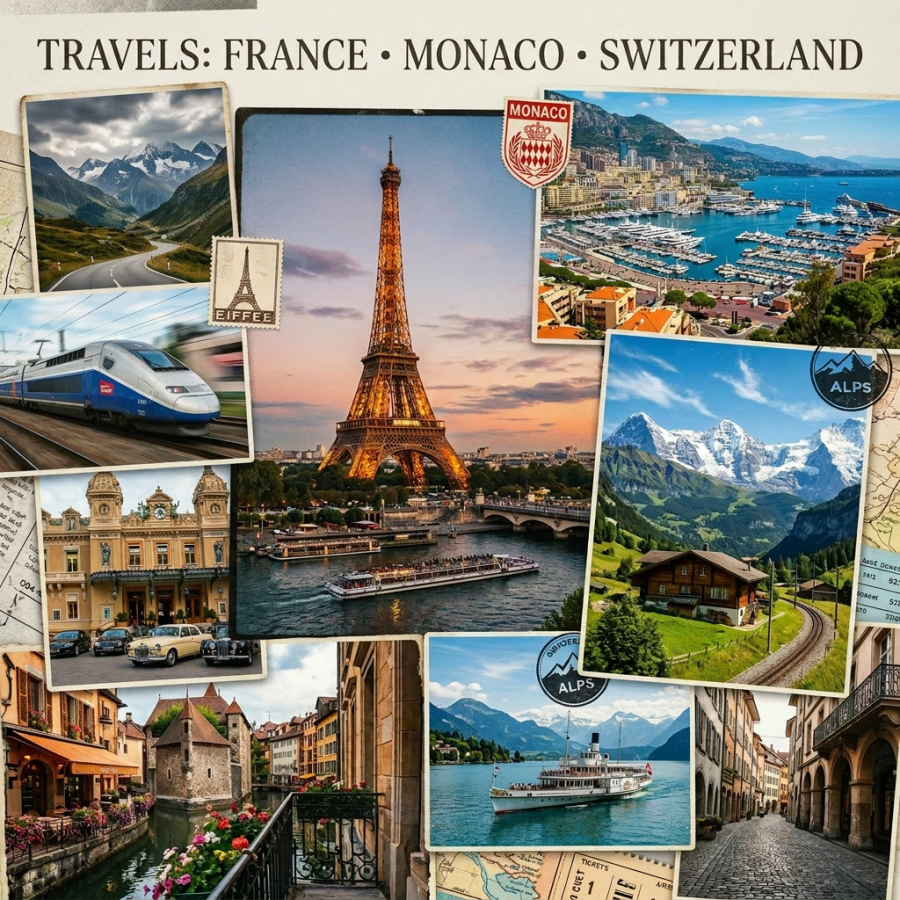
A few days ago, we wrapped up our five-week journey through France and Switzerland.
Overall, the vacation was a great success. We visited countless beautiful places and, thanks to George—our resident expert at striking up conversations with locals—we even came home with a few new friends. Of course, there were also a few less pleasant moments, mostly related to some of the rental properties where we stayed, which caused us stress we could have done without. But that’s the nature of travel: not everything goes according to plan.
All things considered, we came back with wonderful memories and the satisfaction of having discovered remarkable places and met some truly interesting people.
France
France is a magnificent country, with landscapes that range from rolling hills to towering mountains, from vast plains to winding rivers—like something out of a perfectly illustrated geography atlas.
We met warm and polite people—and by that I mean native French locals, not immigrants who arrived over the past 30 or 40 years—and their impressive history, ancient, rich, and fascinating, was one of the reasons we wanted to visit in the first place.
France has a way of revealing itself that draws you in immediately. It is not merely beautiful; it is spectacular in many different ways.
The Alps and the Pyrenees make you feel as though you have entered another world, with dramatic peaks, glacial lakes, and villages seemingly attached to the mountainsides.
The gentle hills of Burgundy, Dordogne, and Provence roll across the landscape like green waves, dotted with vineyards, lavender fields, and medieval villages appearing exactly where you would hope to find them.
The broad plains of northern and central France are peaceful and orderly, with old farms and roads that look as though they were drawn with a ruler.
And the rivers—Loire, Rhône, Seine, and Garonne—are the lifelines of the country. Along their banks, you find castles, elegant towns, historic bridges, and an atmosphere that encourages you to slow down and simply enjoy the moment.
France seems to have an almost instinctive respect for its surroundings: well-maintained roads, immaculate villages, carefully cultivated fields, and parks and gardens that always appear freshly tended. Whether you are in a tiny village far from everything or in a major city, you sense the same attention to detail.
Almost everywhere we went, people were open, friendly, and eager to explain, recommend, or share stories. They carry a special pride in their region, their traditions, and their cuisine—and they are more than happy to share that pride with visitors.
France does not need to prove that it has history. You see it in the castles, cathedrals, fortifications, medieval villages, museums, ancient bridges, and even in the names of its streets. It is a country where the past is not simply decoration; it remains a living part of the landscape.
Before I had the chance to get to know France better, I shared the classic stereotype about the French: that they are a bit arrogant, a bit full of themselves, and convinced that the rest of the world has something to learn from them. After spending five weeks there, however, I started to understand them better.
When your country has landscapes like these, centuries of history, a remarkable culture, and world-famous cuisine, it is hard not to feel proud. France truly is special. Everywhere we went, we found postcard-perfect villages, impressive castles, centuries-old cathedrals, or breathtaking views that made us pull the car over just to admire them for a few minutes.
After this trip, many of the preconceived ideas I had brought with me simply disappeared. What remained instead was a deep respect for what the French have managed to build, preserve, and cherish over the centuries. And I have to admit that, after seeing it all with my own eyes, it is difficult to blame them for being proud of their country.
One thing I realized after spending five weeks there is that Paris is not France. Or perhaps more accurately, Paris is only one of France’s many faces. It is easy to confuse the two, especially if your entire impression of the country comes from the capital. But after traveling through several regions, I often felt as though I was experiencing completely different worlds.
Paris undoubtedly has its own charm. More than once, I had the feeling that Paris is a universe unto itself rather than an accurate representation of the rest of France. It is spectacular, vibrant, and full of life, but it is also incredibly exhausting. The crowds never seem to disappear, and public transportation feels like a form of organized chaos: dozens of metro lines, buses coming from every direction, cars honking endlessly, and people who appear to have absolutely no patience. The pace of the city makes it feel as though the entire planet has gathered there at the same time, everyone rushing somewhere, everyone focused on their own business, each contributing to an energy that never seems to stop—not even at four o’clock in the morning. Literally. We tested that theory firsthand.
I also have to admit that I made a rookie mistake there. I did not do enough research before booking our apartment in Paris, and I failed to study the different arrondissements to understand which areas were worth staying in and which ones were best avoided. I chose mainly based on price and photos, only to discover later that location matters enormously in a city this large, where the differences between neighborhoods can be dramatic. Lesson learned for next time.
Once you leave the capital behind, however, the scenery changes almost immediately. Towns and villages become quieter, cleaner, more colorful, and filled with flowers. Life moves at a gentler pace, and people always seem to have time for a smile, a recommendation, or a brief conversation—even when your French leaves a lot to be desired.
That is where I discovered the France that truly won me over. Not the France of famous monuments and postcard attractions, but the France of picturesque villages, wheat fields sprinkled with red poppies, winding roads cutting through beautiful landscapes, and places where time seems to move a little more slowly. It is a subtle kind of beauty. It does not try to impress you, and it certainly does not boast about what it has. It simply exists. And somehow, it is precisely that authenticity that makes you fall in love with it without even realizing it.
Monaco
There is not a great deal I can say about Monaco because we were only there for a day trip. It was enough to form a first impression, but not enough to truly get to know the place.
I liked it very much. The scenery is stunning, the combination of the sea and the cliffs plunging toward the coastline is spectacular, and the city has that elegant, well-kept appearance that constantly makes you stop and look around.
What surprised me most, however, were the prices. I had expected Monaco to be absurdly expensive—perhaps even more expensive than Switzerland. From what we saw, at least in the shops and restaurants near the beach, that was not the case at all. Prices seemed comparable to those in France and, in many cases, more reasonable than what we encountered in Switzerland.
Of course, we did not have time to explore luxury boutiques or investigate the real estate market—I’m sure that would have been a completely different story. I am speaking strictly from the perspective of a tourist who wandered around, had a meal, and bought a few everyday items.
Honestly, one of the biggest surprises of the trip was discovering that Monaco, a place many of us associate with wealth and luxury, felt more affordable than both Switzerland and even Saint-Tropez. If someone had told me that before the trip, I probably would not have believed them. 😄
Switzerland
Switzerland was every bit as wonderful as I remembered it from last year, when we used to take day trips there from Milan. Without a doubt, it is one of the most beautiful places I have ever seen.
Everything looks like a postcard: spectacular mountains, impossibly blue lakes, immaculate villages, and scenery that makes you pull over every few kilometers just to take another picture.
But there is also a downside: Switzerland is incredibly expensive.
Many Europeans may not understand what I mean, but my point of reference is Canada, where I have lived for more than thirty years. Compared to the prices back home, Switzerland felt genuinely shocking. I constantly had the impression that almost everything cost two or three times more than what I am used to paying in Canada.
A few days ago, gasoline was 1.99 Swiss francs per liter, a two-liter bottle of water cost about 2 francs at Migros, and the trip up to Jungfraujoch – Top of Europe cost us 120 Swiss francs per person. Even everyday purchases quickly remind you where you are: a baguette sandwich that costs €8–10 in France costs about the same number in Switzerland, only now the currency is Swiss francs.
The issue is not necessarily the cost of a single item. The problem starts when you add everything together: accommodation, food, fuel, parking, cable cars, trains, coffee, and the occasional snack grabbed on the go. By the end of the day, the total rises alarmingly fast. Honestly, I am still shocked by how much money we spent in just a few days.
I still do not fully understand how locals manage such a high cost of living. Obviously salaries must reflect it, otherwise the system simply would not work. But viewed through the lens of Canadian prices, Switzerland was by far the most expensive country I have ever visited.
And yet I have to admit something: when you stand there looking at those almost unreal landscapes, you understand why so many people dream of coming here. Your wallet suffers, but your eyes are rewarded every step of the way. 😄
People and Customs
One difference I noticed almost immediately was the contrast between the French and the Swiss.
The French, especially those living outside the major cities, are surprisingly talkative. And if you happen to have George around—a man capable of striking up a conversation with virtually any living creature—you stand a good chance of leaving with a few new friends.
The Swiss are different. More reserved, more private, more… like me.
They are extremely polite, respectful, and courteous, but they do not feel the need to turn every interaction into a conversation. You get the sense that they do not want to bother you under any circumstances, and they expect the same consideration in return. If the French operate on a “let’s chat for a few minutes” principle, the Swiss seem to prefer “good morning, thank you, have a nice day.”
I’m not saying one approach is better than the other; they’re simply different. Personally, I found myself relating quite a bit to the Swiss style. Still, I have to admit that the warmth and spontaneity of the French led to a few encounters and conversations that we will not forget anytime soon.
Housing and Architecture
Another difference that immediately caught my attention was the contrast between French and Swiss homes.
In France, many houses have personality. They are colorful, decorated with flowers, fitted with wooden shutters, and often have little imperfections that only add to their charm. You get the feeling that each house tells a story and that successive generations have added their own touch over the years. They may not always be perfect, but they feel welcoming and alive.
In Switzerland, the impression was almost the opposite. The houses are clean, orderly, and impeccably maintained, but also much more restrained. I was actually surprised to see fewer flowers and ornamental gardens than I had expected. What stood out instead was the emphasis on practicality and upkeep. Everything seems well organized, functional, and carefully maintained, without any desire to attract attention.
If I had to summarize it in a single sentence, I would say that French homes felt warmer and full of character, while Swiss homes felt more orderly and reserved. Just like the people. 😊
Fashion
Another stereotype I had before arriving in France concerned the legendary elegance of French women. I expected to see impeccably dressed women on the streets of Paris, wearing carefully curated outfits and carrying that effortlessly chic style celebrated in magazines around the world. Reality turned out to be somewhat different.
The heat wave we experienced may have played a role, but honestly, I did not see much of that famous sophistication. On the contrary, most women I noticed were dressed very simply and practically. What surprised me most was the minimal makeup. In many cases, it seemed to consist of little more than lipstick and mascara—if that. That does not mean people looked unkempt. Quite the opposite. Everything appeared natural and effortless.
To be honest, I felt that influencers and social media have sold us a much more glamorous version of French women than the one I encountered in real life. What stood out to me most was the complete absence of ostentation. I rarely came across the perfectly styled Parisian woman we so often see in magazines and on Instagram. Most women were dressed simply, wearing little or no makeup at all. The elegance was there—it was simply subtle and understated.
Paradoxically, I think that may be the real difference between perception and reality. The elegance we associate with France does not seem to come from extravagance or a desire to impress. It comes from simplicity, confidence, and the absence of excess. Even so, I have to admit that the real Paris was quite different from the Paris I had imagined before arriving there. 😊
In Switzerland, the impression was somewhat similar. If France stood out because of its naturalness, Switzerland stood out because of how little people seemed to care about fashion and how much they valued comfort.
Perhaps the oppressive heat had something to do with it, but it felt as though everyone was dressed for a hike, a bike ride, or a day outdoors. There was plenty of sportswear, practical clothing, comfortable shoes, and very little concern for appearances.
Bern was an even bigger surprise. With temperatures well above anyone’s comfort zone, large numbers of people could be seen carrying towels and wearing swimsuits as they headed toward the Aare River. At first, I assumed there was some kind of sporting event taking place. Then I realized that, for locals, this is perfectly normal. They simply jump into the Aare and let the current carry them through the city. It is one of those images that stays with you: people finishing work and heading off for their afternoon “commute” … in a river.
Conclusions
Overall, we loved the trip. We saw extraordinary places, met interesting people, collected wonderful memories, and learned a few lessons for future travels. There were stressful moments, accommodations that tested our patience, and days when the heat made us question whose brilliant idea the itinerary had been in the first place.
But when all is said and done, it was absolutely worth it.
Even so, there is one feeling I experience after every long trip: the joy of coming home.
I cannot quite explain why, but every time I return to Canada, I realize how well we have it here. Yes, Canada has its problems. Yes, we complain about plenty of things. But after spending several weeks away, you begin to see your home through different eyes. Somehow, many of the things that normally irritate you start to seem much less important.
In fact, the moment I truly felt the vacation had ended was at border control in the airport. When I saw the Canadian border officers, I almost felt like hugging them. I restrained myself, of course—I wasn’t entirely sure they would appreciate that. 😄
I did tell them that I was happy to be home, and that perfectly summed up how I felt. One of the officers winked at me and smiled, a clear sign that he knew exactly what I meant.
France and Switzerland were wonderful, and I would gladly return to either of them someday. But at the end of the day, nothing compares to the feeling of opening your own front door and saying: “That’s it. I’m home.” ❤️
Discover more from "The world is your oyster".
Subscribe to get the latest posts sent to your email.
